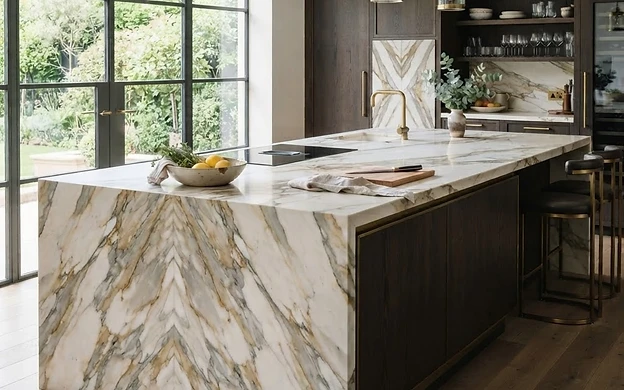
Bookmatched marble, done right
Mirrored veining can look stunning — or busy. A guide to placing bookmatched panels where they earn their cost.
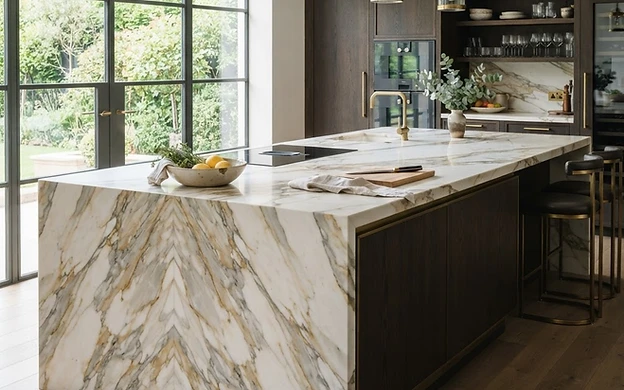
Bookmatching is when two consecutive slices from the same marble block are opened like a book and placed side by side, so the veining mirrors across the join. The result is a symmetrical pattern that can look extraordinary — but it can also look busy and overwhelming if it’s not placed thoughtfully.
The key is restraint. Bookmatched panels earn their cost when they’re used as a feature — a splashback behind the hob, an island end panel, or a full-height wall behind the sink. Used across every surface, the mirrored veining competes with itself and the effect is lost.
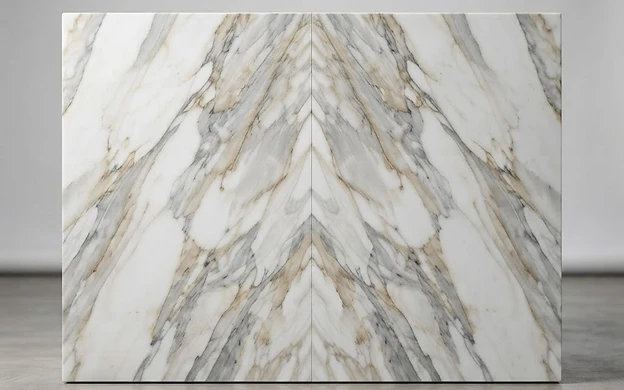
Choose your slab with the bookmatching in mind. You want bold, directional veining — Calacatta and Arabescato marbles are the classic choices — because subtle, cloudy patterns don’t read as mirrored. Ask your fabricator to show you the dry-laid bookmatch before they cut, so you can approve the placement.
Marble is softer and more porous than quartz or granite. It will etch (dull spots from acidic contact) and it can stain. Many people accept this as part of the patina — a lived-in, natural surface that ages gracefully. If you want pristine perfection, marble isn’t the right choice. If you love character, it’s hard to beat.